
Updated: Jan 20
Consider the scenario of racing down an-darkened hallway in a hospital with a patient in need of an IV insertion. The vein is shallow, the patient is anxious, and the clock ticks away. Such experiences in healthcare environments are far from rare compared to most realize. The ability to locate a vein in such a high-stress, low-visibility environment is no easy task.
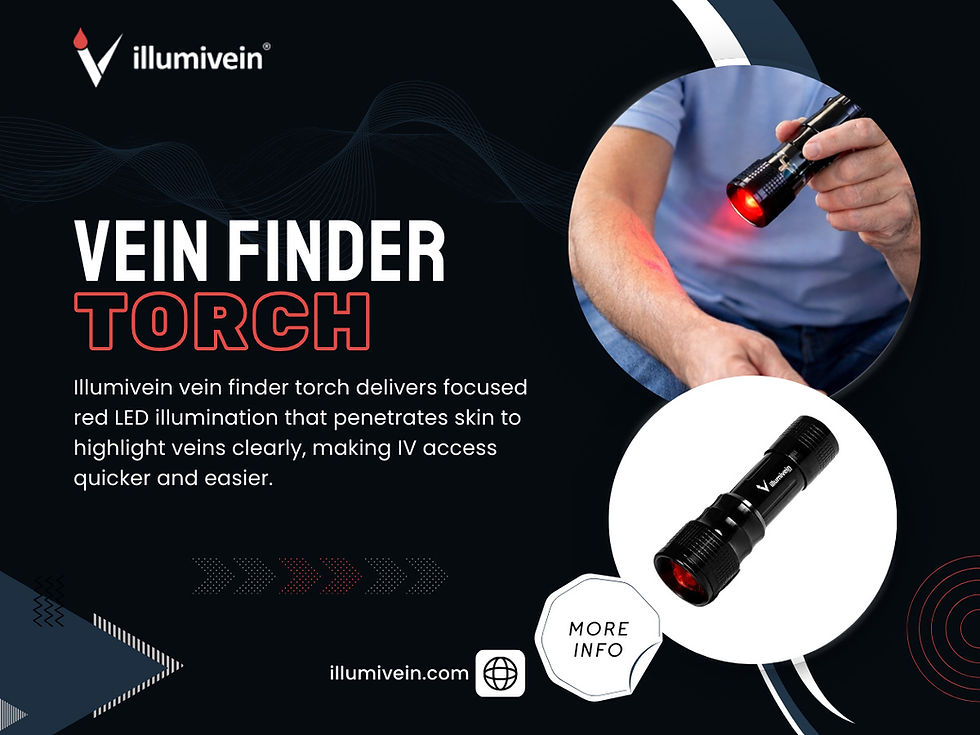
This is where a vein finder torch comes into its own. In this way, it allows the veins to be highlighted underneath the skin in real time, and this can help to transform confusion into clarity and also make patient procedures less painful for the patient while also helping the doctor to complete procedures quickly and safely.
The Challenge of Low Visibility in Clinical Settings
Low visibility situations are more common than many realize. These include:
Dimly lit hospital corridors
Emergency response settings with minimal lighting
Patient rooms where overhead lights are insufficient
Home care visits at night or during power-saving periods
Even in well-illuminated environments, the presence of “hidden” access sites may be influenced by patient skin color, depth of veins, dehydration, or fragile veins. Conventional approaches, including palpation, tourniquet use, and visualization, may not be effective in such situations.
What a Vein Finder Torch Does
A vein finder torch employs near-infrared (NIR) illumination to illuminate the veins under the skin. Hemoglobin absorbs this illumination in a manner different from the surrounding tissues, causing the veins to be visible as dark lines. This happens because:
Clear vein mapping even when skin tone or lighting conditions would otherwise obscure veins
Ability to identify vein depth, direction, and size before insertion
Reduction in guesswork and unnecessary needle sticks
In contrast to a fixed vein finder lamp, a torch-type device is portable and can be placed at any angle, which allows healthcare professionals to adjust according to the position of the patient and environment.
Real-World Applications in Low Visibility
Emergency Departments
In emergency care, healthcare professionals may have only seconds to obtain IV access. Additionally, poor lighting conditions, agitated patients, or trauma can make it very difficult to locate veins. A vein finder torch enables healthcare professionals to:
Identify veins quickly
Decrease the time taken per attempt
Reduce patient discomfort during stressful situations
For paramedics and emergency personnel, the ability to move around is essential. A torch can be worn or attached to equipment, which is always handy.
Pediatric Care
Children, especially infants and toddlers, tend to have small, deep-lying veins that are hard to access even in optimal lighting conditions. Anxiety, movement, and fear make it even more difficult.
A vein finder torch helps clinicians:
Locate veins before attempting insertion
Minimize trauma from repeated attempts
Enhance patient and parent confidence
In pediatric settings, this device has been proven to offer a significant improvement in first attempt success rates, which is of utmost importance in terms of both the quality of care and the psychological well-being of the patient.
Geriatric and Long-Term Care
Older adults frequently have fragile veins that collapse easily. Many have chronic conditions or a history of repeated IV access, making vein selection difficult.
A portable vein finder torch can:
Reveal deeper, more stable veins
Prevent bruising or hematoma formation
Help to provide safer and more effective care in low-light rooms or home care visits
It allows clinicians to maintain patient dignity and comfort while ensuring safety.
Advantages of Using a Vein Finder Torch Over Traditional Methods
The use of a vein finder torch in low visibility conditions has a number of important advantages:
1. Increased Accuracy
By visually highlighting veins beneath the skin, clinicians can:
Reduce failed attempts
Choose the most appropriate vein for insertion
Avoid fragile or damaged veins
2. Faster Procedures
When veins are visible from the start, IV insertion is faster, improving workflow efficiency and reducing patient stress.
3. Improved Patient Comfort
This means that there will be fewer attempts at injection, which translates to less pain, less bruising, and a calm experience for the patient, especially children and the elderly.
4. Portability and Flexibility
A torch-type device is portable and can be moved easily, which makes it ideal for use in:
Hospitals and clinics
Home care visits
Emergency and mobile healthcare environments
5. Support for Training and Education
New nurses and medical students can use a vein finder app in combination with the torch to understand vein patterns and improve technique before performing procedures on real patients.
How Vein Finder Technology Fits Into Modern Healthcare
Vein finders, including lamps and torches, represent a shift in how clinicians approach difficult IV access. They do not replace skill—they enhance it. In modern healthcare, providers are expected to deliver care that is:
Efficient
Minimally invasive
Safe
Emotionally considerate
Technology like Illumivein’s vein finder torch helps achieve all these goals, particularly in low visibility scenarios where traditional methods may falter.
The Clinical Impact of Reduced Needle Sticks
Repeated failed attempts at IV access can have significant consequences:
Physical discomfort for patients
Increased risk of infection and bruising
Higher stress for both patient and provider
Increased procedure times, impacting workflow efficiency
By improving first-attempt success rates, vein finder torches mitigate these risks, creating a better experience for everyone involved.
Integration of Vein Finder Tools into Workflow
Successful integration demands careful application of the following:
Assessment First: Standard inspection and palpation are done first by clinicians.
Tool Deployment: If the veins are not easily visible or palpable, the torch is turned on.
Vein Selection: The physician selects the best vein according to depth, size, and direction.
Insertion with Confidence: With real-time visual information, the process is carried out with more accuracy.
This method is flexible, repeatable, and reduces unnecessary attempts.
Comparing Vein Finder Options
Each tool has different uses:
Vein Finder Lamp: Offers a wide view, which is ideal for use in hospital settings or multiple access points.
Vein Finder Torch: Convenient and versatile, perfect for use in a low-light setting or on the go.
Vein Finder App: Useful for training and demonstration purposes but not very accurate for real-time clinical use.
The choice of which tool to use depends on the environment and the patient population. Most institutions use a combination of these tools to ensure consistency of results.
Why Illumivein Vein Finder Tools Stand Out
Illumivein designs its products to address real clinical challenges, emphasizing:
Accuracy in low visibility conditions
Portability for mobile and emergency use
Ease of use for clinicians at all experience levels
Compatibility with pediatric, adult, and geriatric populations
Through the integration of design and clinical knowledge, Illumivein assists in the reduction of stress for patients and the improvement of outcomes for clinicians.
Conclusion
Low visibility situations are unavoidable in healthcare. Whether it’s a darkened room, a home healthcare visit at night, or an emergency situation where the stakes are high, the standard approach to vein access may not be effective. A vein finder torch can increase accuracy, improve patient comfort, and boost clinician confidence when every attempt matters.
For medical professionals, the integration of vein finder tools into their workflow is not about replacing skill but about complementing it. Vein finder tools help in reducing failed attempts, minimizing stress to patients, and giving visual assistance to ensure faster and more efficient medical care.
In modern clinical environments, particularly where visibility is a concern, a Vein Finder is not a luxury—it’s a necessity in order to provide quality care.
Related Links:
Related Tag: